
Roman Holiday

This year I discovered a holiday.
Sandwiched into an already full season dominated by the Big Three: Thanksgiving, Christmas and New Years, I’ve failed to notice it all this time. There are no gifts required, it doesn’t have any decorations or Guy Lombardo dirges written in its honor (although it did inspire a Madonna greatest hits album in the Nineties). When you see the name of it, you can understand why it’s not spawned many greeting cards.
Meet my favorite new addition to the calendar: the Catholic Solemnity of the Immaculate Conception, or as it’s known in Italian: the Immacolata.
Perhaps one reason I skipped it before is that it’s hard to know how to wish people a good one. “Enjoy your Immaculate Conception” feels awkward. So does “What are you doing for Immaculate Conception?”, or “Fai una buona Immacolata” (“Make a good Immaculate Conception”). No wonder it often seems to pass without mention.
If you’re wondering when this clumsily-named occasion transpires, you’ve already missed it. The feast day itself falls on December 8, but like America’s Thanksgiving, it’s a celebration that usually ensures a long weekend, what the Italians happily refer to as “the bridge”. This year, the bridge was crossed on Friday, December 5, leading to the actual feast day on Monday. So yes, it appears your invitation to the party was lost in the mail. Mine too. It might not be an accident.
The national holiday of the Immaculate Conception is actually relatively new, first made official by Pope Pius IX in 1854. If you’re trying to work out the math between the date of the Immacolata and the birth of Christ only 17 days later, you’ll be relieved to know that the occasion does not in fact refer to the Virgin birth of Jesus. Instead, the holiday marks the conception of Mary herself, leaving her untouched by human sin.
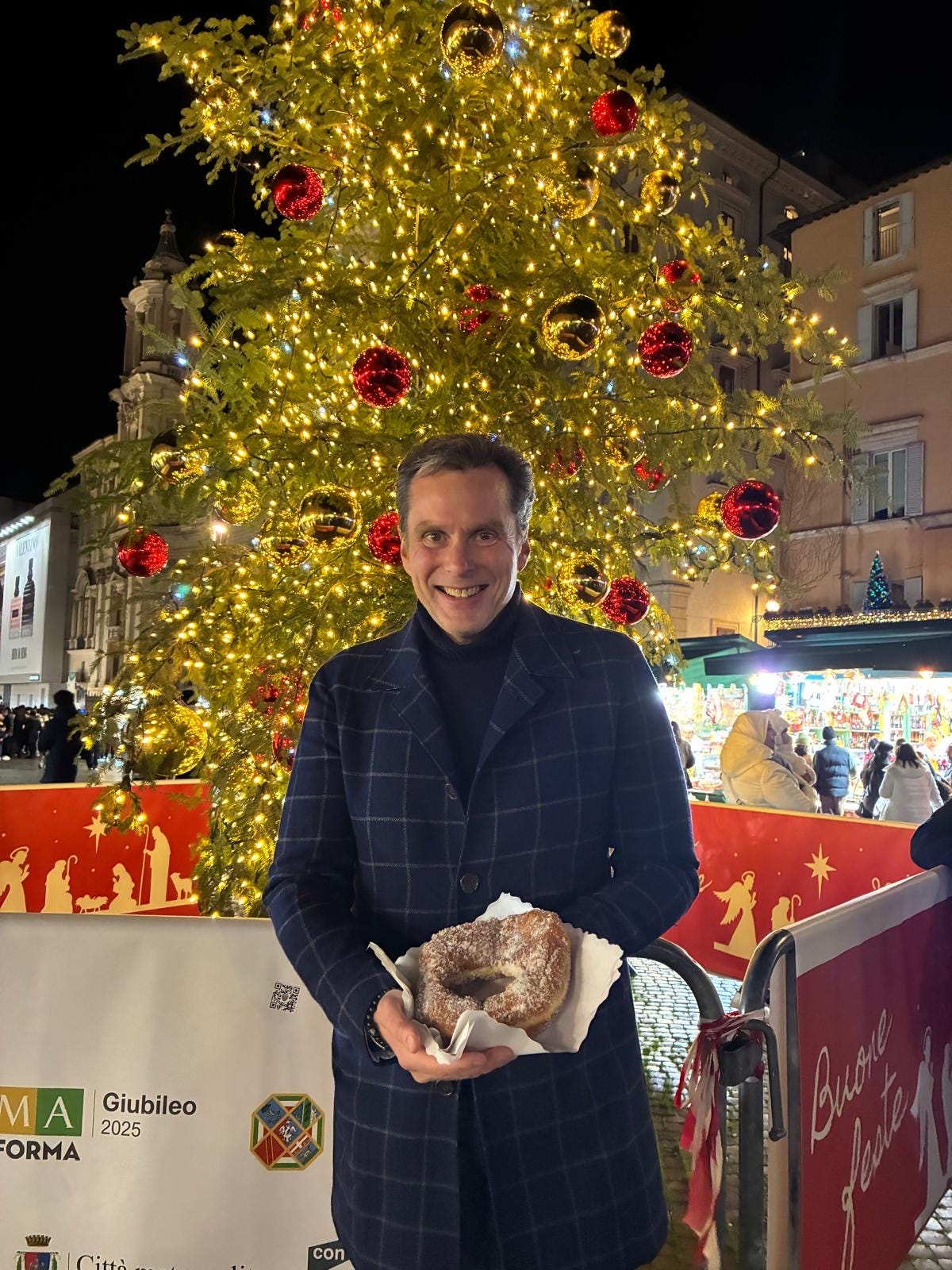
But there’s also a secular side to the festa, which serves as the official Opening Day of the Christmas season. Unlike Americans—ready to kick off Yuletide just as soon as they can get the Party City blow-up skeleton down from the roof—Italians prefer to arrive fashionably late, delaying their start until early December, when at last they light the trees, turn on the music and then carry on all the way until Epifania on January 6. Shorter shopping season; a couple of extra feast days. Every country has its priorities.
Yet it’s not the unveiling of the Christmas village or the arrival of the ciambelle stand in Piazza Navona that moves this particular holiday to the top of my “best excuse for a long weekend” list. I like it not so much for what it ushers in, but for what it restores.
After this year’s long, hot Roman summer and equally busy fall —filled with Jubilee pilgrims and tourists packed into everything from Caravaggio shows to tiny vintage Fiat 500’s that putter around the city for full dolce vita effect— the Immacolata was a moment for the capital to swing open its shutters and welcome back those who know it best: the Romans themselves.
From Friday afternoon, as school kids started to filter into the streets and piazzas with that giddy excitement of kids on break, you could feel the city sliding back to a time before the historic center was consumed by on-off buses and “street food” pasta vendors. That night the bar on the corner was once again a neighborhood pub. The pizzeria was packed with long tables of teenagers, the girls with their long black hair and shiny, puffy winter coats at one end, the boys with their meticulously tousled hair at the other.
In the window across the street from our apartment, so often dark for long stretches, or so filled with laundry that one had to wonder how many dirty clothes could be generated by invisible tenants, a family dinner was in progress. The patriarch, who could have passed for F. Murray Abraham in “The White Lotus”, held court while platters of food circulated like horses on a merry-go-round.
On Saturday, as I cut through Trastevere’s Piazza di Santa Maria, a busker segued from Gnarls Barkley’s “Crazy” into the Italian anti-fascist folk song “Bella Ciao”. By the time he made it to “o partigano, porta mi via”, the crowd began to sing along, knowing the words by heart. Then the chorus spread down the narrow streets until even the blocks outside of the square were full of raised voices.
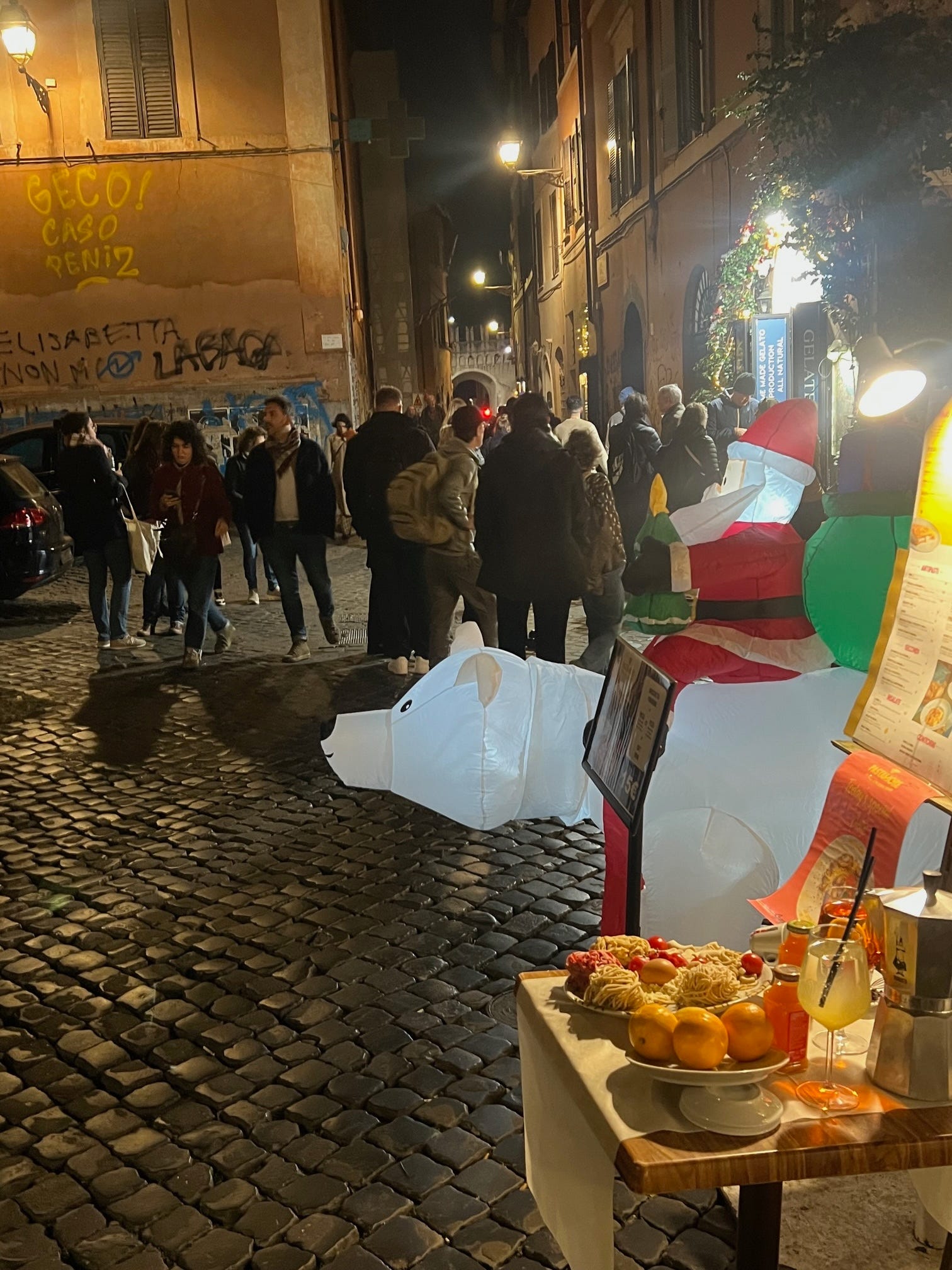
Admittedly, the holiday has its downsides— an Italy full of Italians poses its own problems, as most Italians would freely acknowledge. You have to deal with elderly nonnas, tiny but indomitable, striding in front of you to jump the line, groups arriving at the restaurant in packs of 10 with no reservation but a friend at the front desk, and oversized SUVs careening through the strangled streets as if they were Smarts. It should be noted that Romans are no less likely to block a sidewalk to take photos than any group of foreigners.
Despite the inconveniences they sometimes create, I don’t think most Romans harbor any particular grudge toward tourists. Given how many locals make their living off the flood of humanity flowing in from all corners of the globe, they probably resent them less than the tourists resent each other.
But naturally the natives avoid the places where those streams of people puddle and pool. Over the years, they’ve almost unconsciously ceded great swaths of their city: the most elegant piazzas, storied monuments, and beloved restaurants.
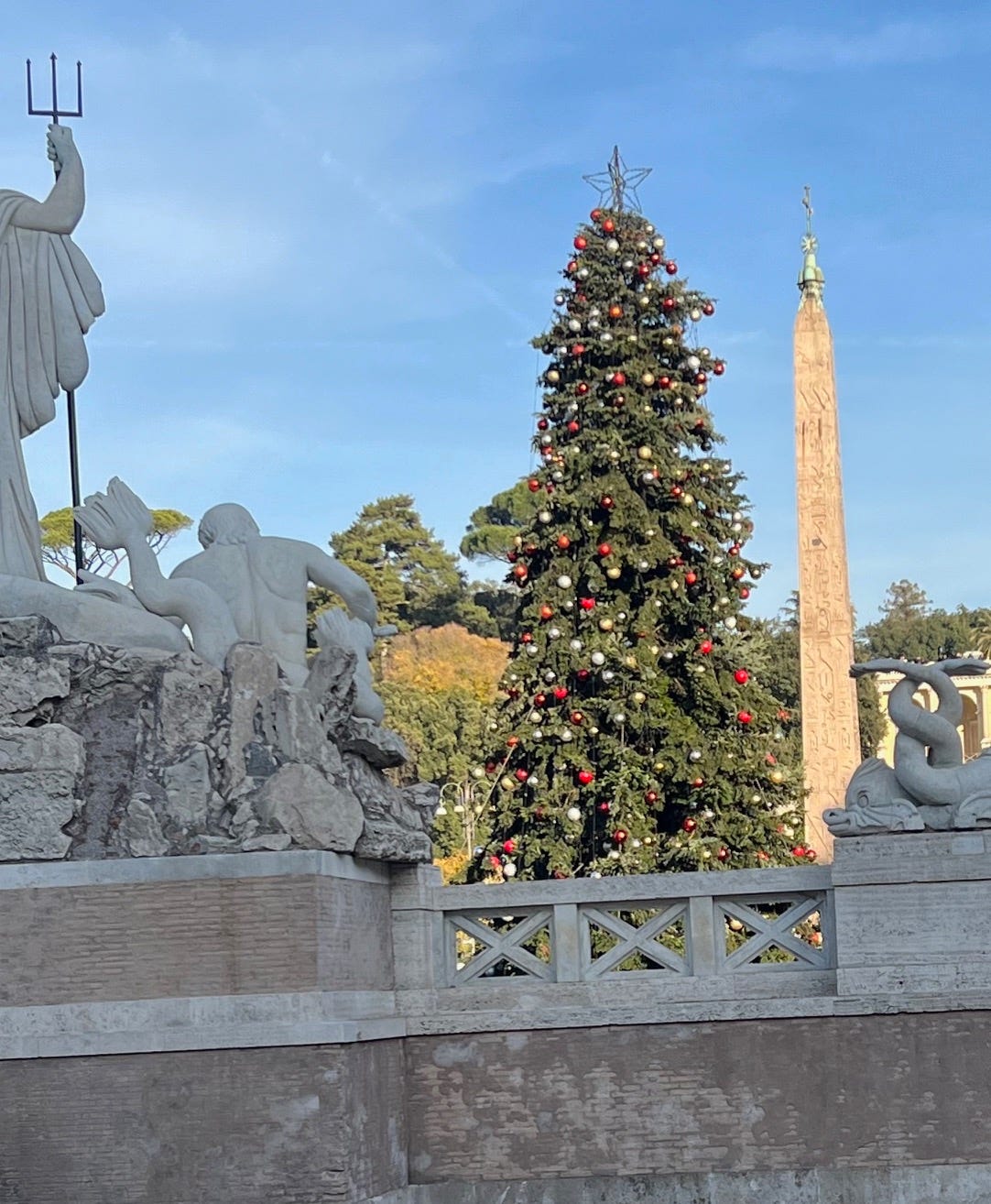
So on the weekend of the Immacolata, when in the company of their neighbors and family, they decide to venture out once again to their old haunts, there’s a sweet pleasure in watching them rediscover their inherited fortune, particularly the very young and the very old. On Monday afternoon in Piazza del Popolo, where preparations were underway for the tree-lighting that evening, young fathers wheeled their well-bundled toddlers in strollers while the mothers walked beside, chatting on their phones. Grandmothers and grandfathers pointed out the sights to the grandchildren— the obelisk, the Fountain of the Four Lions— as if to say: Stop. Look. This is what it means to be Roman.
After opening the doors to Christmas on the Immacolata, C and I spent much of the month in New York and then Oregon. For us too, homecoming is an integral part of the holidays: the soft as a couch comfort of family and old friends; the gentle push and pull of the places that shaped us.
By the time we arrived back in Rome on December 24, the rest of the world had returned as well. Gone was any proprietary claim on the city for those who live there. The Christmas Eve Mass at the Vatican is not a local event, or even an Italian one. It’s a world spectacle, beamed out to 100 countries across five continents.
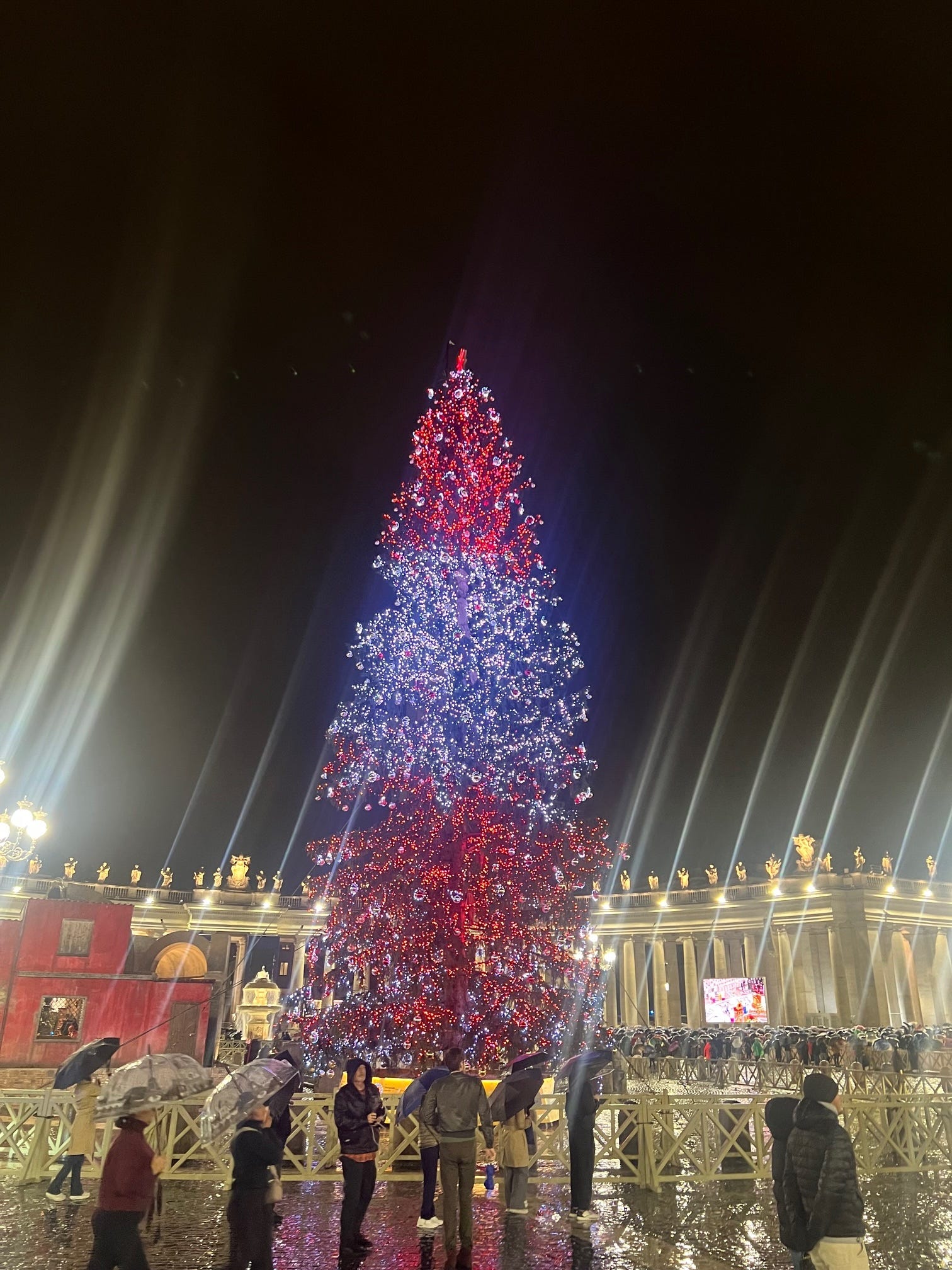
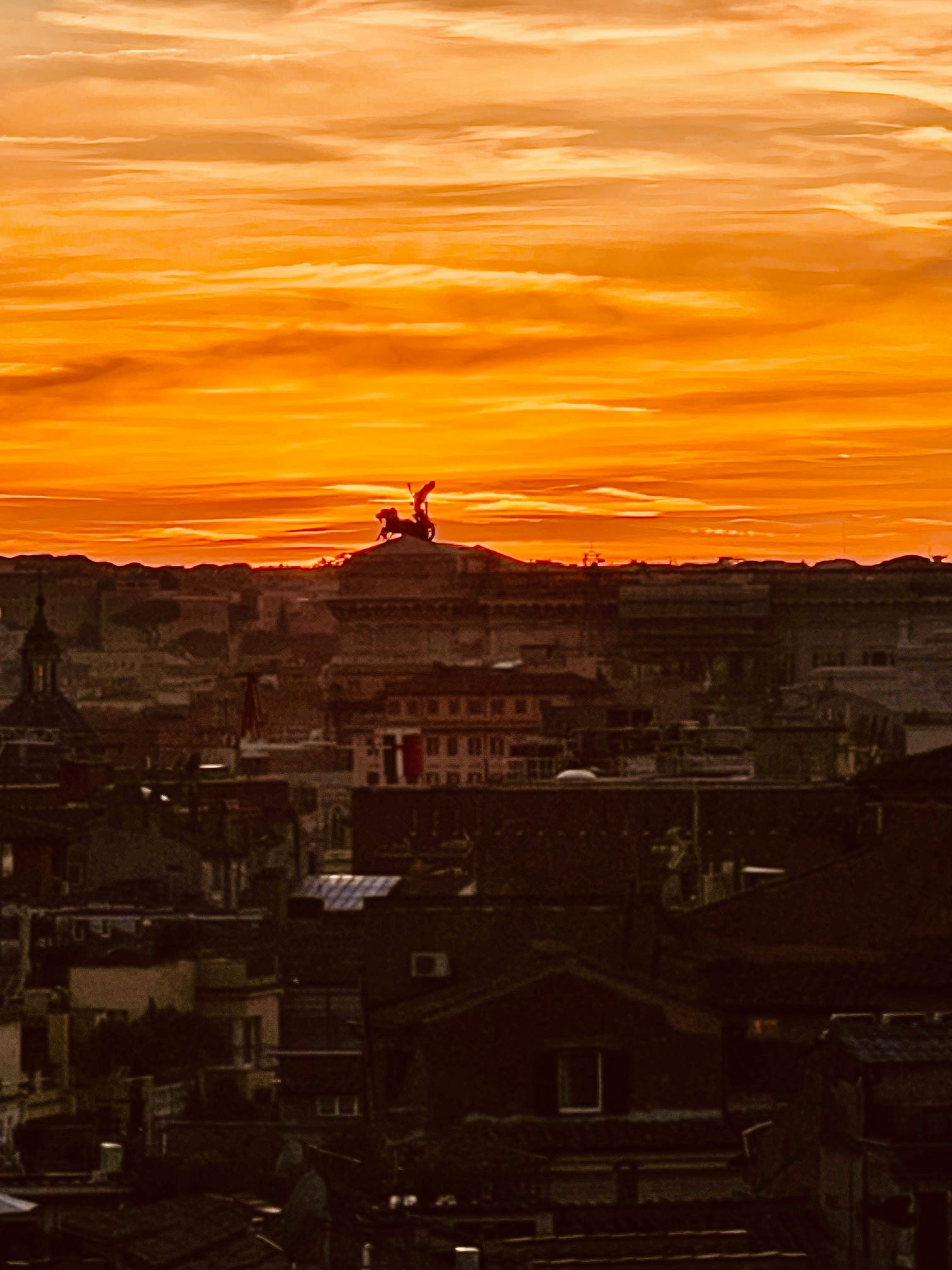
But as the bells rang out across what this year was a rainy, windy St. Peter’s square, my mind drifted back to that Sunday two weeks prior, the eve of the Feast of the Immaculate Conception. I had wandered over to the Giardino degli Aranci on Aventine hill just in time for sunset. From there you can take in a skyline panorama that stretches from the Victor Emmanuel II National Monument to the dome of St. Peter’s basilica, shimmering in the persimmon sky.
When the same church bells sounded that night, echoing over the terraces and terracotta rooftops, even the Romans— cynical, irreverent, having seen it all for nearly three thousand years —stood with something approaching awe. Children perched on their father’s shoulders. Young couples held hands.
That day Rome was once again theirs. For a moment at least, they could feel at home in their own home, reveling in the city they share with the world.
I hope you’ve had a Buona Immacolata, a Merry Christmas, a Happy Hanukkah or Kwanza, and of course I wish you a very Happy New Year. Your support of Life Lived Italian is a true gift and I thank each of you who take the time to read, comment repost or recommend. I’ll see you on the other side of Epifania.
For those with a little extra reading time over the holiday break, I hope you’ll take a minute to visit Via Media Review, a new literary journal on Substack.
I’m very happy to have two short poems in the premiere issue “Both/And”—something very different than what I do for this newsletter. It’s a lovely publication. Please do take a minute to check it out.

Welcome to a world lived Catholic, in Italy. It is precisely these feast days on the official Church calendar that give the true faith good historical backbone. When we were in Rome on pilgrimage, we wandered into the church of Saint Augustine on May 22, only to find one of our favorite saints, Saint Rita, being honored with a Mass and long-stem red roses being handed out. Of course, she was an Augustinian nun and it was her feast day. Her life-sized statue was inside, onto which you could touch her prayer card. When I went to try and get the English version, the 90-year-old Italian man grandly flirted with me, in apology for not having more cards.
And that is just one of the 900 churches in Rome.
Thank you for an excellent read, as always. Looking forward to seeing you both in Marche soon!