
Game On

It seems everyone’s competing for something this month: Seahawks versus Patriots, Bad Bunny against Kid Rock, Heathcliff battling Edgar for Catherine at Wuthering Heights, Fedez taking on J-Ax at Sanremo.
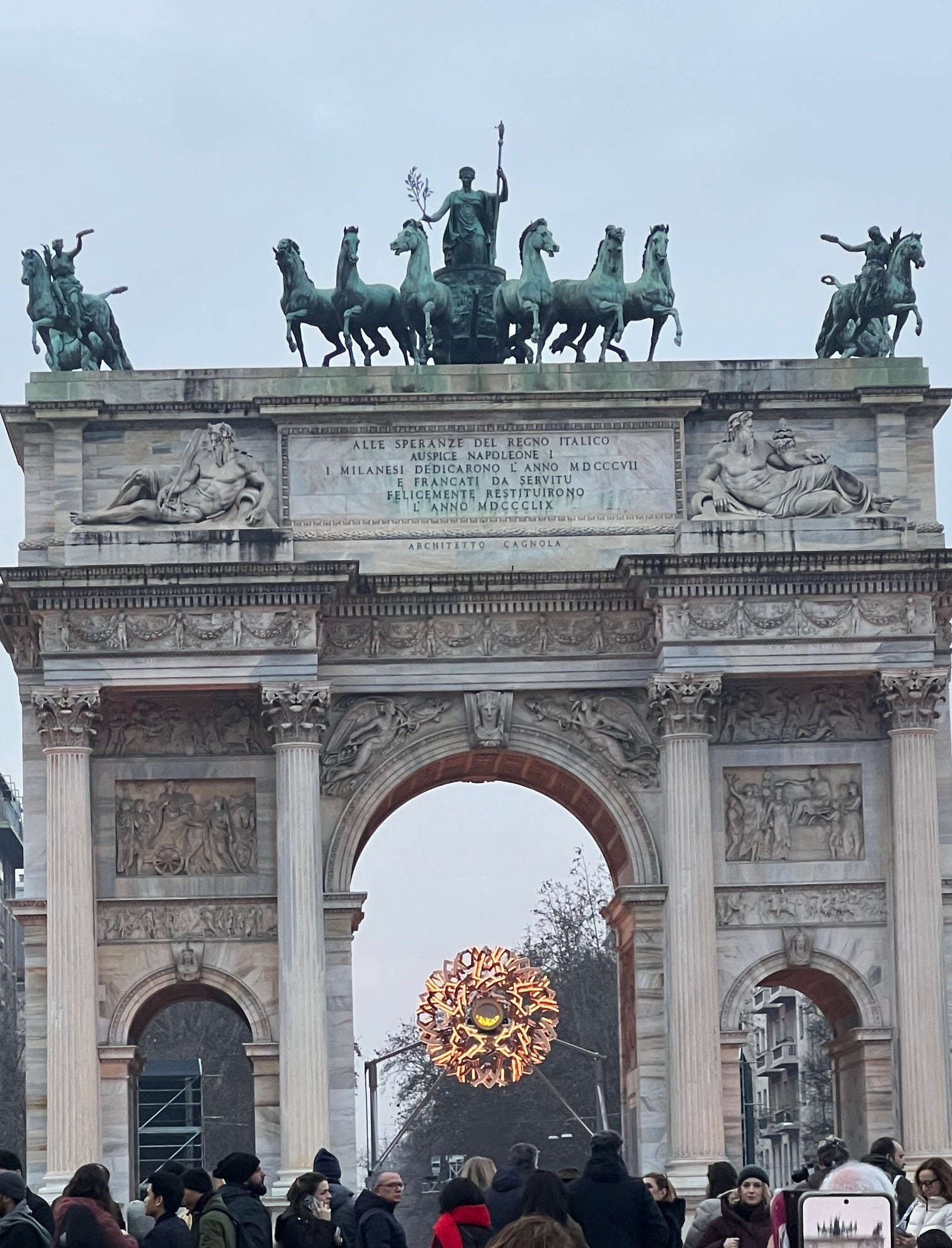
And then there’s the mother of all competitions: the Winter Olympics, with drama spread over 19 days, 116 medal events and 6 locales: Milan, Cortina d’Ampezzo, Livigno, Bormio, Tesero, and Verona. This one is the ultimate challenge, and speculation has been swirling for months:
Could Italy manage an epic that could compete with Beijing or Korea?
Would Italy’s “Golden Duo” bring home the curling Gold?
Would the builders get the bathrooms installed in time at the hockey stadium?
Could Mariah Carey make it through a phonetically spelled out version of “Volare” ?
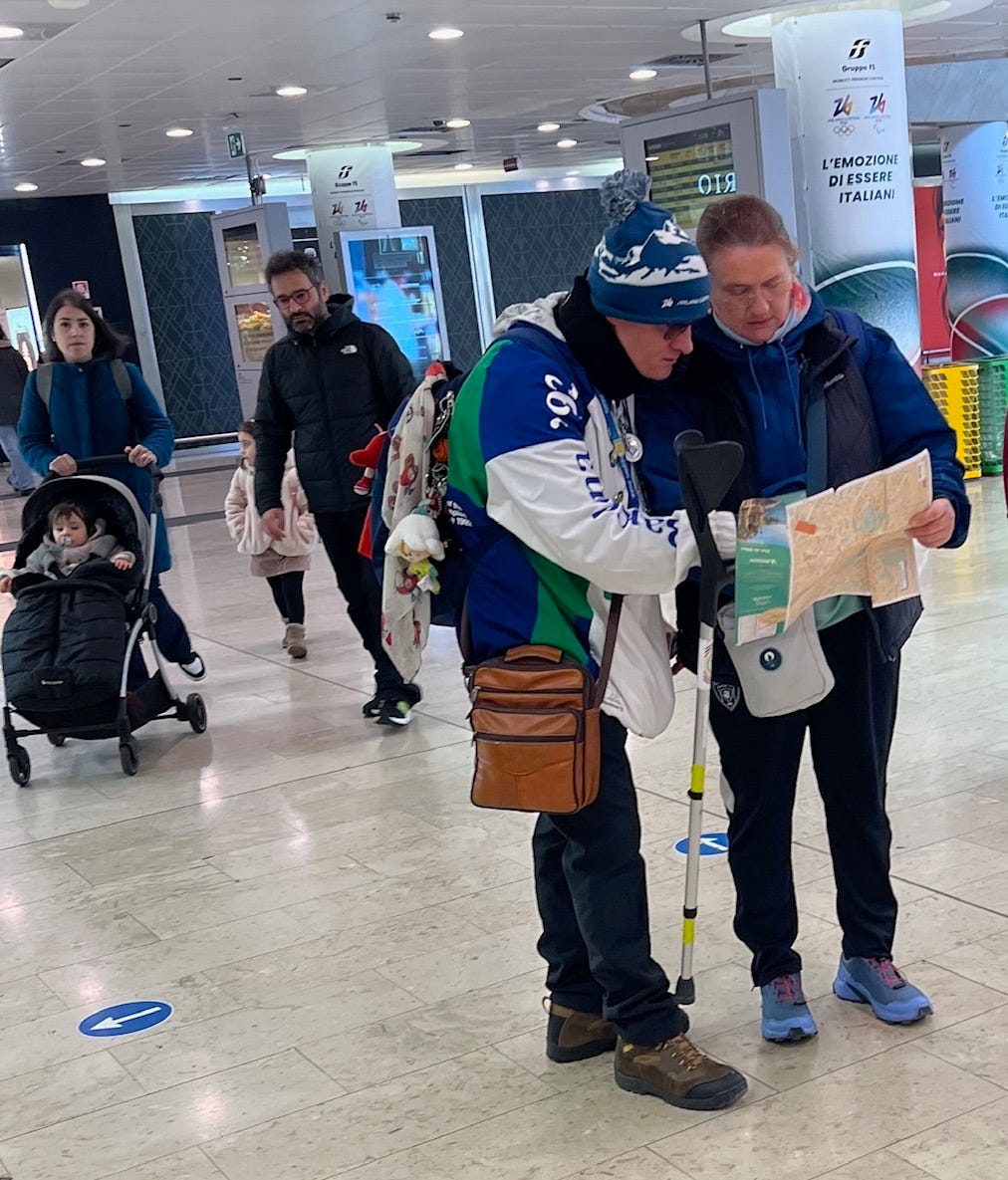
By early February, the air in Milan—even if it was decidedly spring-like for a Winter Olympics—was fraught with anticipation and the critics were armed with both flags and knives, equally prepared to celebrate the thrill of victory or the agony of defeat.
To be fair, the Olympics are an undertaking that simultaneously plays to Italy’s greatest strengths— beautiful settings, generous hospitality, a flair for spectacle— and exposes its greatest weaknesses— organization, fiscal management, timeliness. So it’s not surprising that the pregame predictions were pretty dire, while the actual experience, at least so far, has been something else all together.
“It’s Milano, it’s your vibe” read the banners and signs that recur like a leitmotif around the city, a shot of azure across the grey, business-like facade of one of Italy’s least vibey towns. Did someone have the snowboarders write the slogans this year?
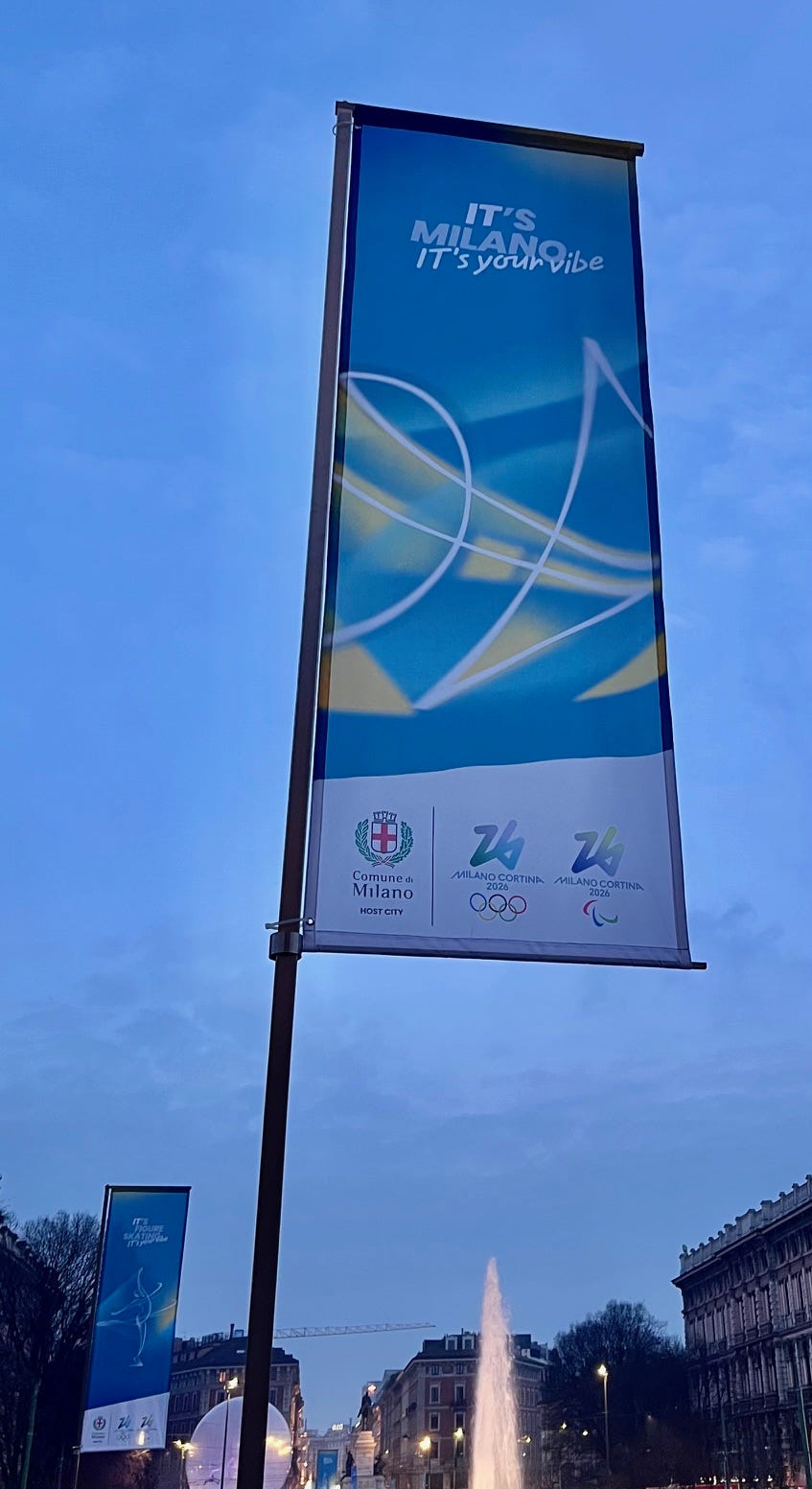
At every turn (“it’s figure skating, it’s your vibe!”), Milan finds itself draped in “no worries” positivity. Unfortunately, the locals have been far more focused on sky-high ticket prices, construction scandals, half-finished stadiums, and the presence of ICE (the kind you run from, not the kind you skate on). As the city staggered to the opening ceremony like a student after a week of cramming for finals, the vibes were decidedly grumpy.
But on Friday evening, with the sacred space of San Siro ready to host one last mega-event before its demise, the flag-bearers put on their Armani suits in the tricolore, Andrea Bocelli trotted out “Nessun Dorma” and everyone did their best bella figura until the Italians had seduced even themselves, paying tribute to a national culture that is easy to criticize but almost impossible to fully resist. By the time Francesca Lollobrigida, grandniece of the Dolce Vita era film icon, brought home the gold medal in the 3000 meter speed skating on the first day of competition—then did her post-win interview holding her two-year old son in her arms—the vibe shift was complete.
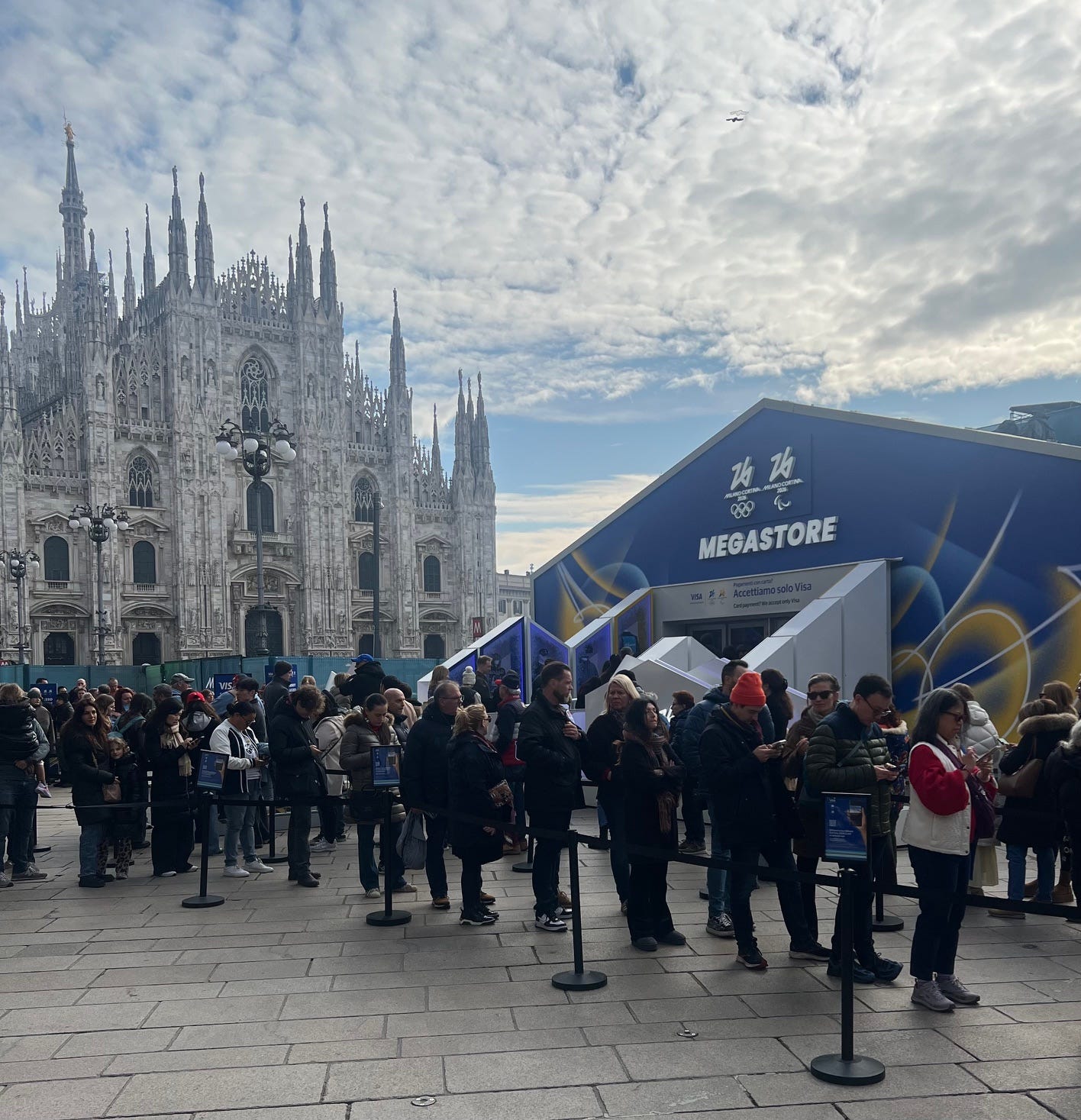
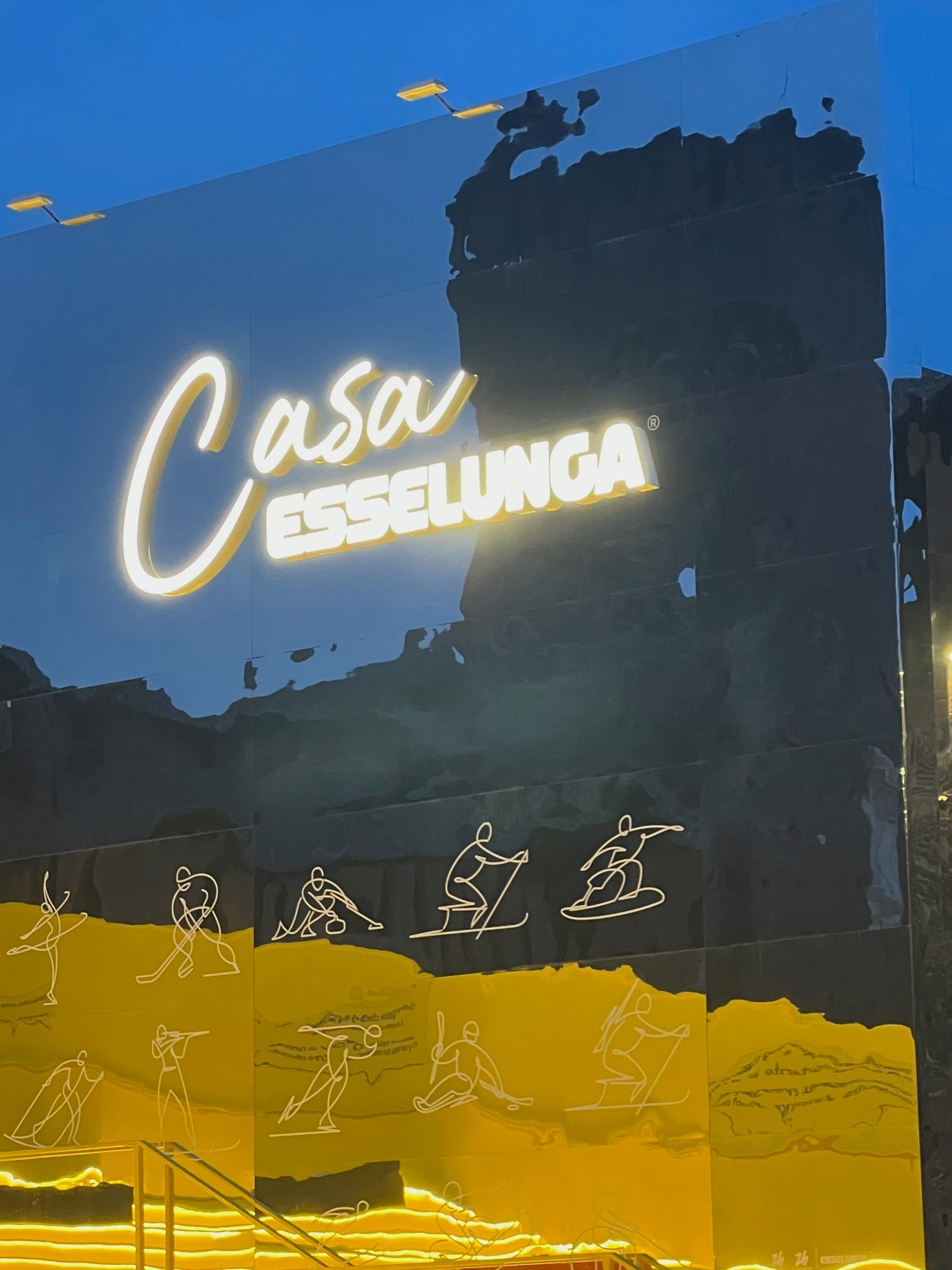
Strolling through the city last Sunday, the Olympic spirit was in full flame, at least on a commercial level: the line in front of the Olympics mega-store stretched out like a piste along the Piazza del Duomo. Meanwhile over at the Casa Esselunga pop-up, a matching crowd cued for a plush toy in the shape of a focaccia. Every company from Fiat to Moncler to the local baker had hitched their star to the Olympic rings, but it felt less like exploitation than an effort to share in the moment, by those who might not know a luge from a skeleton. Or a twizzle from a death spiral. Or a pebble from a puck.
“We’re going to see what?” C said, when I informed her that we were about to have the once in a lifetime experience of attending an Olympic game. Granted, my event selection process had weeded out some of the major crowd-pleasers. Having discerned that the only way in or out of Cortina in less than six hours was by helicopter and that even something as baffling to me as ice-dancing would run 500 euros per ticket, I decided to opt for a more focused methodology:
What was the cheapest event I could attend that was happening in Milano?
Answer: Women’s ice hockey.
“It’s Italy versus Japan,” I explained, as C stared at me blankly. “Do they even play hockey in either place?” she queried.
I had to admit that a Japanese girl suiting up for hockey was hard to picture. Likewise in thirty years in Italy, I’ve never heard mention of even an amateur hockey game, for either gender. “Maybe one of them will be like the Jamaican bobsledding team,” I suggested, thinking of the Cinderella story in the movie “Cool Runnings”. “Besides, we’ll get to see the new hockey stadium”
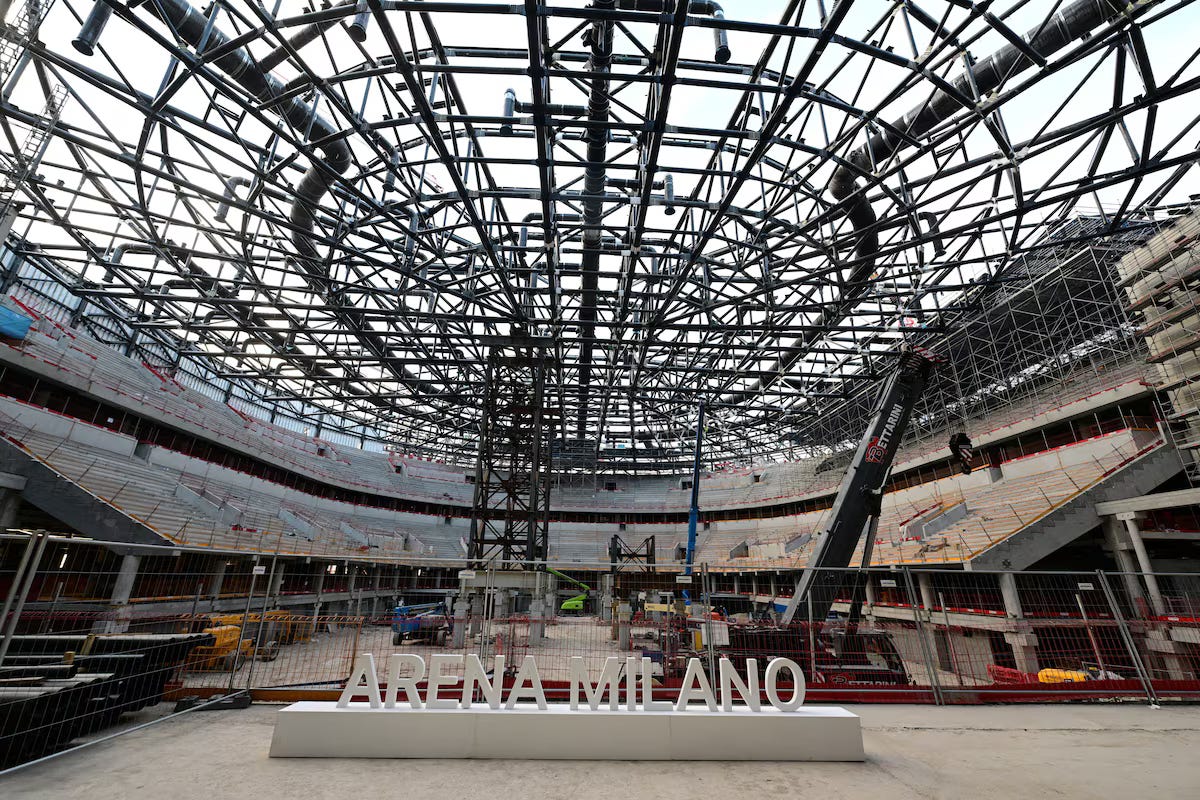
.That new stadium, Santagiulia, had been the bullseye on the target for those taking shots at Milan’s management of the Games’ major construction projects. When it opened for previews just days before the competition, it was described as a frantic work in progress, still missing light fixtures and toilets. The National Hockey League, which is sending players for the first time since 2014, even threatened to withdraw, citing concerns that its slightly smaller than regulation rink could lead to an increase in high-speed collisions. I get the concerns about the bathrooms of course. But aren’t “high speed collisions” the whole point of hockey?
As it turns out, neither the Italians nor Japanese would be running much risk; the women’s preliminary events were not held at the new stadium but rather at Milano Rho, a temporary venue in the Fiera Milano convention centre. It’s one of several arenas in what had been designated Ice Park, then hurriedly renamed “Winter Park” after the Americans managed to give ice itself a bad name.
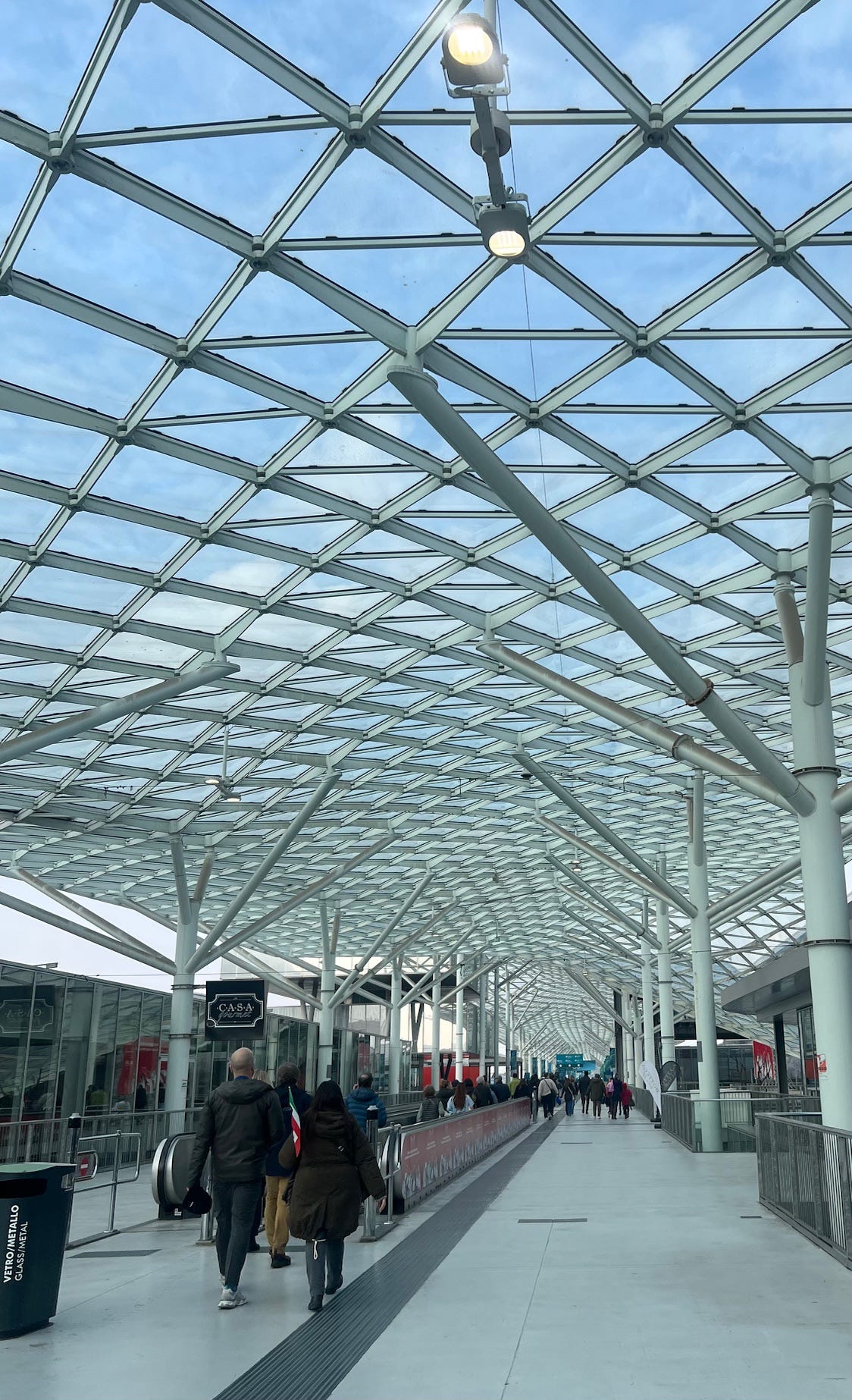
Fiera Milano hosted the 2015 World’s Fair, and its space-age futurism reflects Milan’s position as a center of modern design. However, the hockey arena is at the opposite end of the facility from the Metro, which means you approach your once in a lifetime experience by wandering down a vibe-sucking walkway that stretches out like a corridor at Amsterdam’s Schiphol airport. Only the periodic appearance of snappily-dressed volunteers giving you the finger (a large foam hand they use to point the way ahead) assures you that there is indeed a game going on somewhere around the finish line.
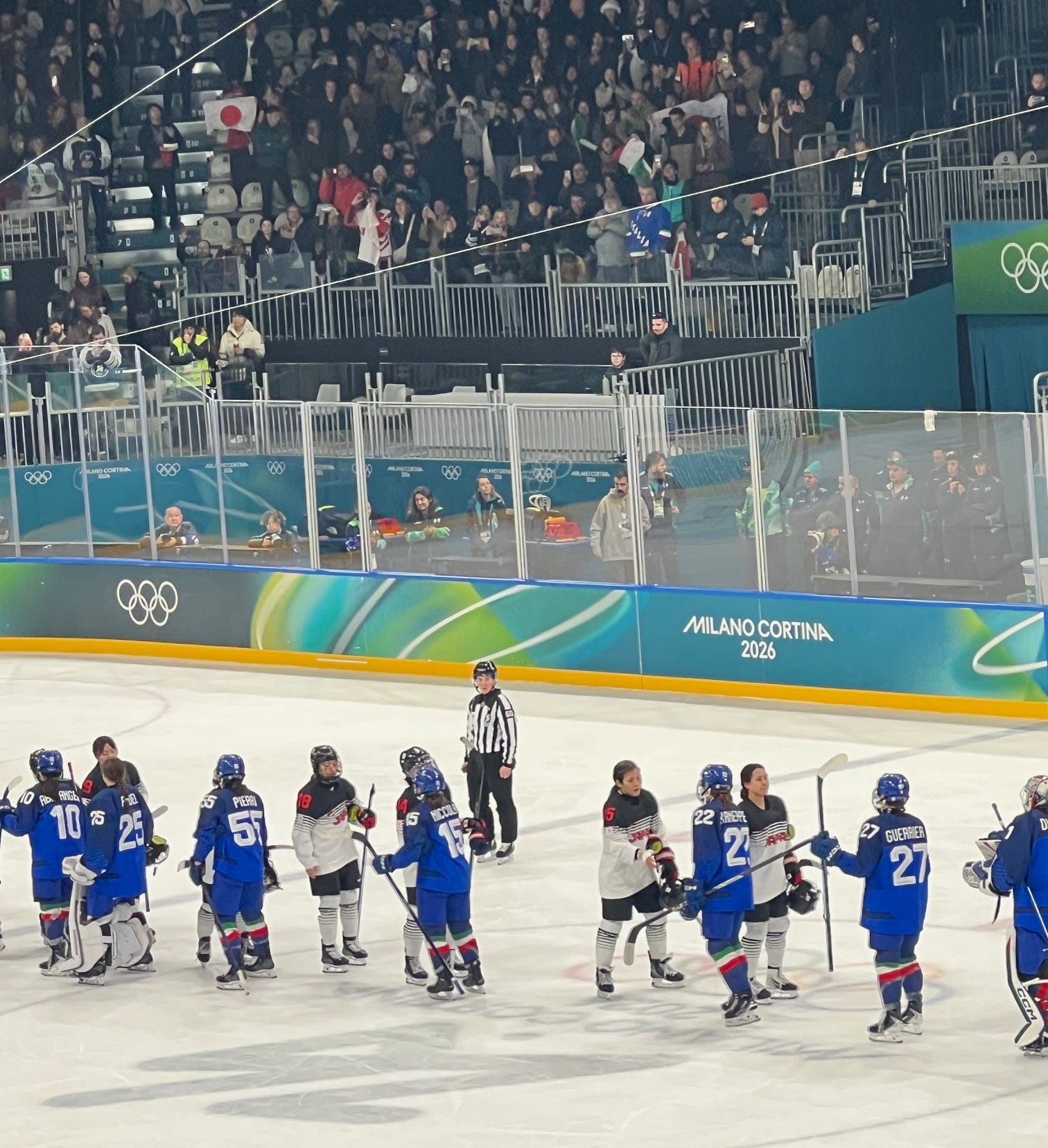
Once you make it inside, you realize that an Olympic hockey game is not unlike a hockey game anywhere. The action is fast and furious and the women’s version is no less physical than the men’s. Italy jumped out to a quick lead on a goal by Matilda Fantin, a 19 year old from Como who plays for Penn State. Minutes later, Fantin struck again, putting Italy up 2-0.
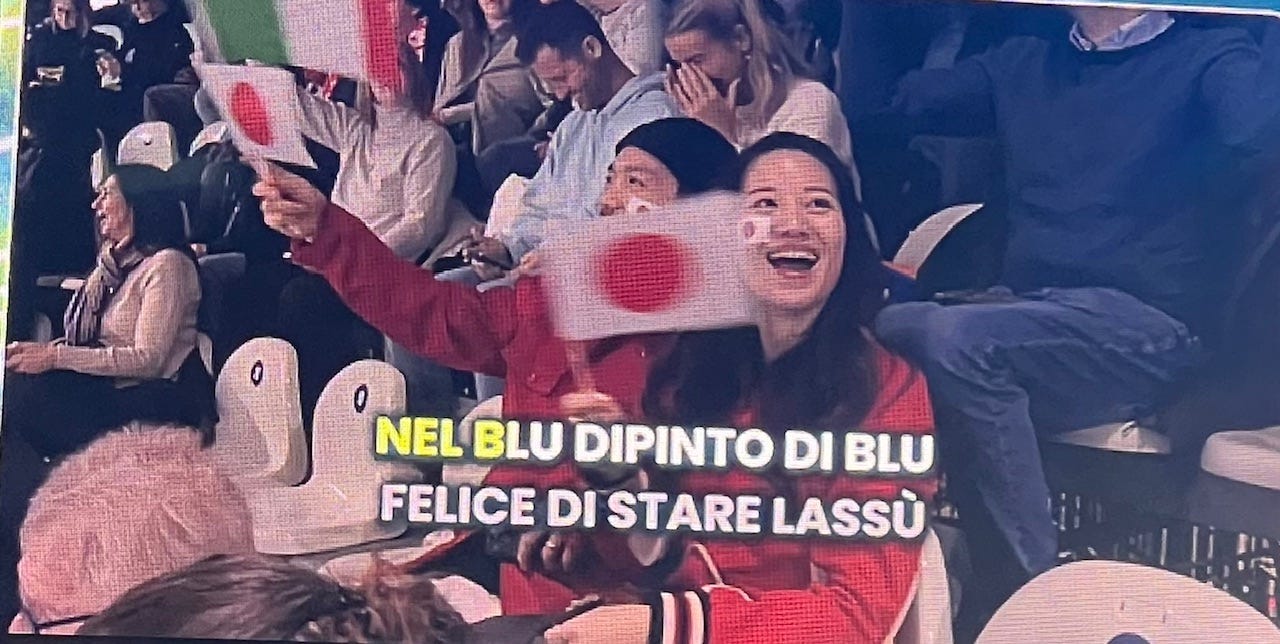
As if that wasn’t enough to get the hometown crowd revved up, there was an admirably international playlist of cheesy electronic dance music and a Mistress of Ceremony who roamed the crowd like something out of an Italian wedding party. “Now it’s time for karaoke…” she announced as we ended the first period. Then to much acclaim, Tina the ubiquitous white weasel that serves as the mascot of Milano-Cortina 2026 came out to lead the crowd in one more round of “Volare”.
Perhaps inspired by the karaoke, the Japanese struck back in lightning fashion to pull within a goal and the two well-matched teams battled closely for the next 40 minutes. The Italians, eventually adopting the determinedly defensive posture that seems to be the national default position in everything from soccer to politics, held on for a well-deserved victory that sent Tina and the crowd into a twirl.
I admit that I’ve always been a skeptic when it comes to the Olympics: too much corruption, too many stadium boondoggles, too much commercialism. But when you’re in the middle of it, there’s no denying the genuine joy that comes from seeing an arena full of sports fans from around the globe— people waving Italian flags of course, but also Japanese supporters in kimonos, along with Dutch in their bright orange sweatsuits, Canadians, Americans, Koreans, and Finns.
Many of course are friends or families of the competitors, fervently cheering on their young people chasing a dream. Even better, many are also cheering on the young people of other places, recognizing in them the same desire and perseverance and vulnerability they see in their countrymen. Not many other things in this world can accomplish that.
It’s a strange quirk of human nature. Send people off to a peace conference and most of the time they come back girding for war. But send them off to compete with one another and they come back friends.
Maybe the Greeks were on to something. The struggle to overcome obstacles, whether it’s sliding down a frozen gutter lying on your back or building a stadium on a deadline, is what we all have in common. Competitions are our crucible. It’s where we find common ground and discover the best in ourselves and one another.
So what if we wind up with an ice rink we never use again? Maybe thousands of years from now, someone will uncover it and surmise that elaborate performances were once held here, at which people from around the world wore improbable costumes, shared good vibes, and were judged on their ability to dance in ice-skates.
God knows what they’ll make of the weasel.
I love watching the figure ice skating competition, they make it look so easy . thanks for your insights...
Great piece. Best I've read about the Milan end of the Olympics. I'm on the other end. I'm covering alpine skiing in Cortina for Colorado Public Radio. Beautiful setting but putting Italians in charge of transportation is like putting Saudis in charge of a pub crawl. You can't get anywhere. Here's my take I did on my first night on the town in Cortina: https://dogearedpassport.substack.com/p/my-night-in-italys-chicest-town-with