
Good Bones

I’ve never been much for looking at bones. Not because I’m squeamish. I’m just not sure what I’m looking for.
If as Shakespeare writes in “Julius Caesar”, “the evil that men do lives after them, the good is oft interred with their bones”, then it should be noted that several centuries later, it’s hard to stare at those bones and catch much of the charity or self-sacrifice that went with them. It would seem that good has a short shelf life.
So when upward of 300,000 people converge on a small village in Umbria to look at a skeleton from the 1200’s, you have to wonder what it is they came seeking. And you have to be at least a little curious to know if they will find it. Maybe it was that kind of curiosity that led us to Assisi last week, for the exhibition of the bones of St. Francis. Maybe it was something more.
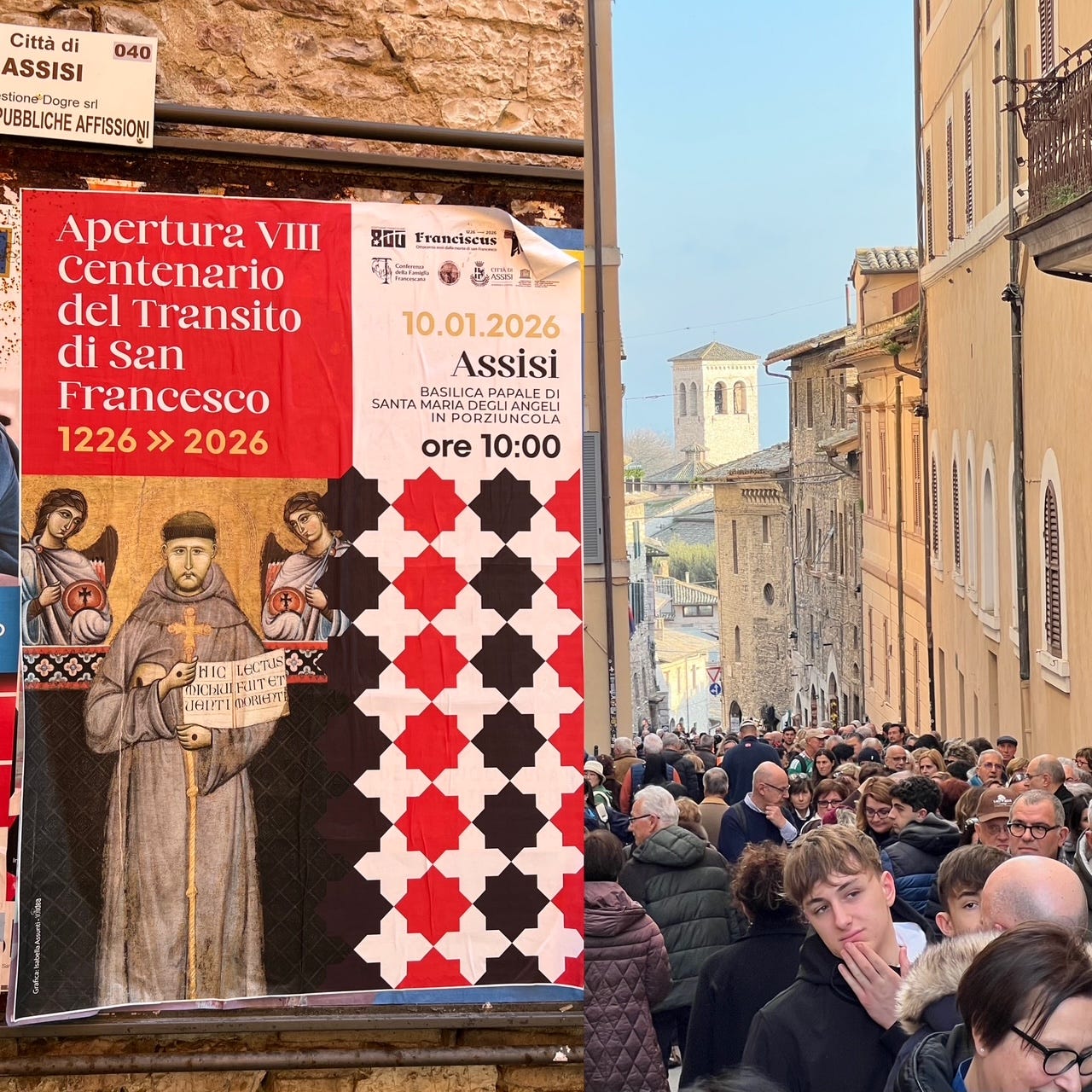
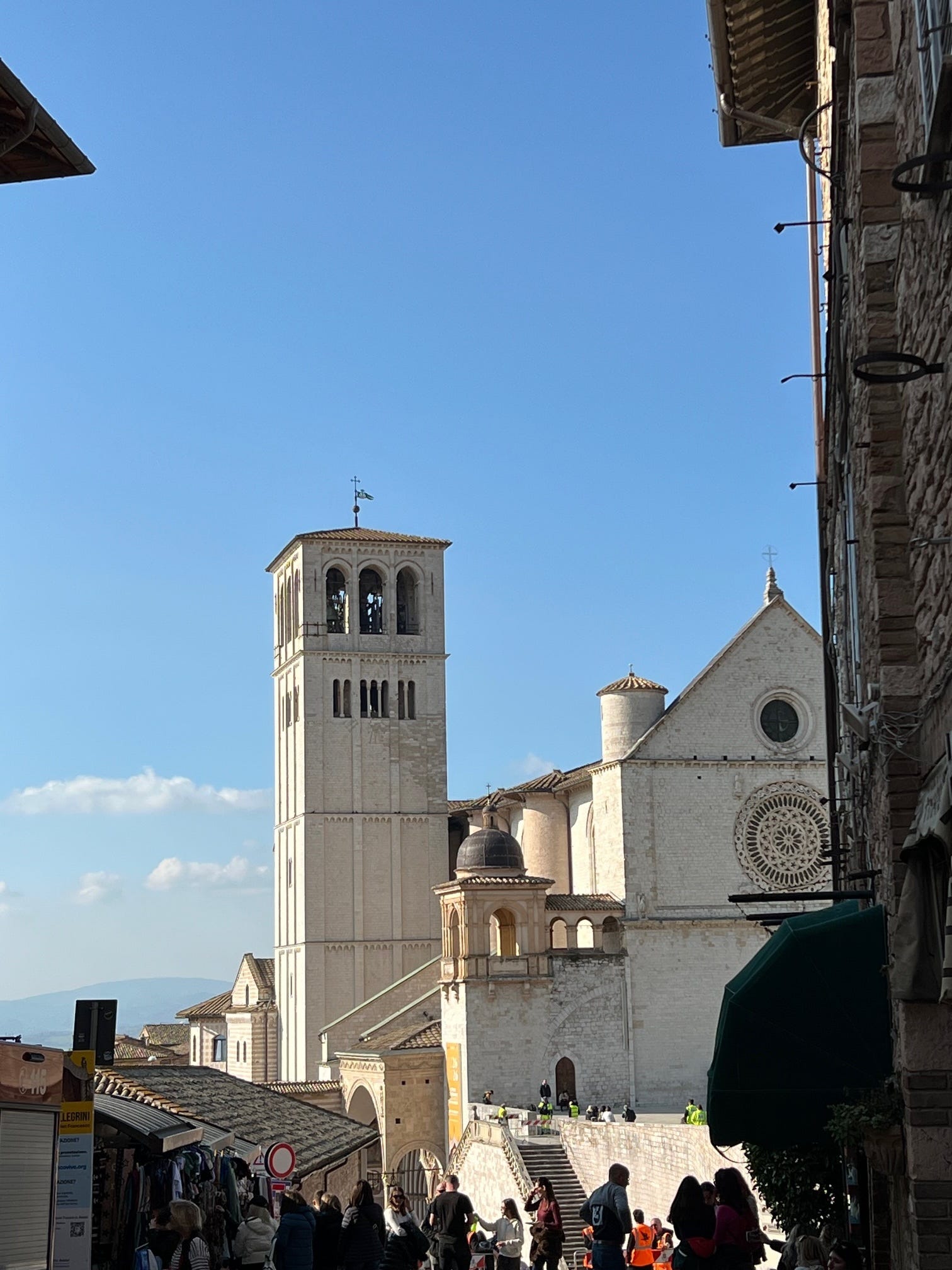
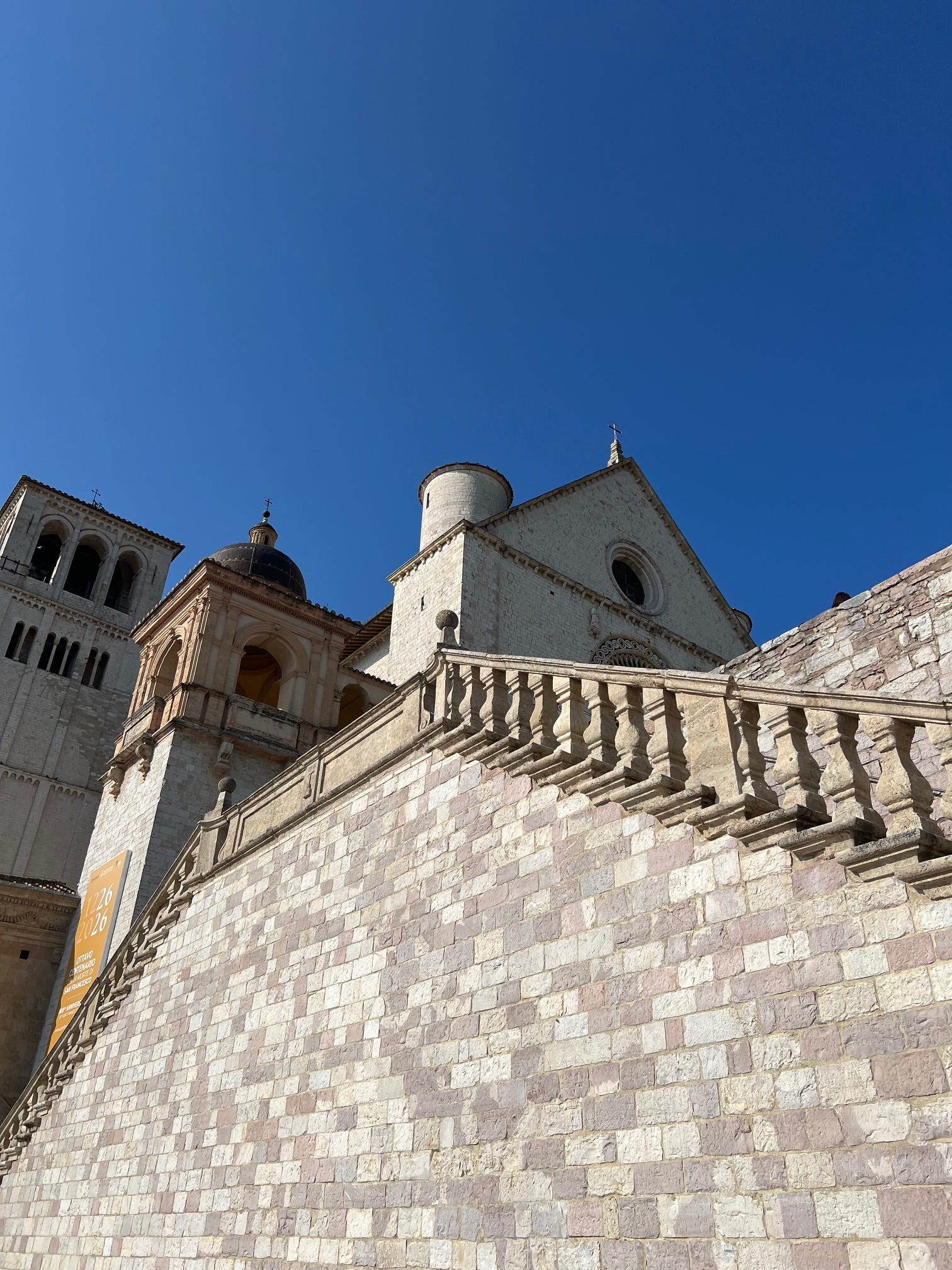
The “veneration” of St. Francis, which began on February 22, takes place in the Basilica of St. Francis in Assisi, a medieval masterpiece that dominates the western edge of this rugged, stony city on a hill. For the first time in 800 years, his remains are open for public viewing to commemorate the anniversary of his death.
Obviously, there’s more to the event than the bare bones: the month-long program includes a theological conference, a Youth Gathering, and a vigil for members of the Italian Parliament—which will certainly put the saint’s powers of enlightenment and inspiration to the test. Yet above all, this is a moment for pilgrims from around the world to come and pay homage to the Little Poor Man of Assisi who has inspired popes and lay people, social activists, animal rights advocates and conservative theologians alike, and of course artists of every kind.
In approving and blessing the exposition, Pope Leo XIV predicted it would deepen our understanding of the Franciscan legacy of peace, reconciliation and fraternity in a world conflicted by conflict and division. He could have also safely added that it would lead to long lines, a cavalcade of buses and a not particularly welcome boom in off-season tourist traffic in this already well-trod town.
But if there’s one thing I learned last year during Rome’s Jubilee year, one punctuated by the death of Pope Francis and the election of Pope Leo, it’s that the Catholic church excels at crowd control, thanks no doubt to a couple thousand years of trial and error. Like the biblical image of a shepherd guiding his sheep, they are very adept at herding people together and moving them along.
So even if the lines stretched far down the hill below the church on the Friday afternoon we arrived in Assisi, the town managed to maintain at least some of its mystical tranquility. The faithful waited patiently outside tents into which a new group was gathered every half hour, then ushered into the Lower Church, under which lies the crypt of the saint himself. The veneration is free to the public but tickets have to be reserved in advance for a timed entry. One can choose between a self-guided experience and one led by a Franciscan brother.
Upon entering the basilica, the Franciscans gently requested that there be no photos and that phones be switched off. These days, that might be the most radical proposition of spiritual re-ordering that could be put forward. Nevertheless, at least this afternoon, the crowds respectfully complied. Silence reined. Giotto’s frescoes, depicting scenes from the life of St. Francis, did the work they’ve done for centuries, lifting eyes and spirits somewhere higher. Our guide offered a soft-spoken homily, shared some prayers, and illuminated several stories illustrated in the frescoes before leading us to the special table upon which the Saint’s skeletal remains are displayed under glass.
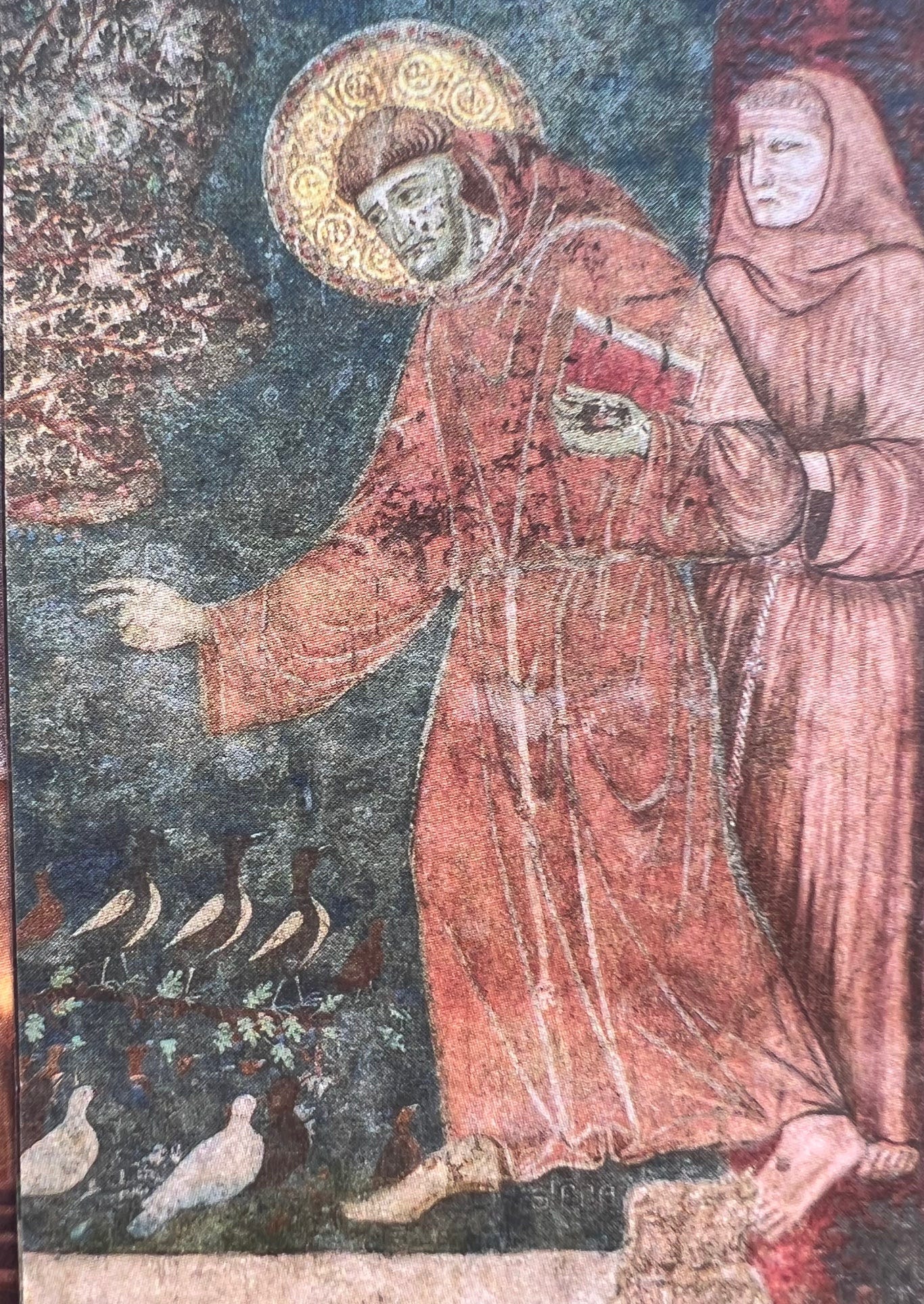
It turns out, those bones are a pretty good story onto themselves. When Francis surrendered to what he called “Sister Death” at an age estimated to be around 45, he was originally buried in the church of St. Giorgio in his hometown; the basilica having not yet been built. It was two years later, after his canonization by Pope Gregory IX that the foundation for the new church was laid. That was also when Francis’s follower Brother Elias exhumed the saint’s corpse and hid the body in a deep, unmarked grave in the Lower Church. Presumably, he did so to protect it from Saracen invaders and the even more severe threat of medieval relic-hunters, looking to make what would have been the 1200’s Heist of a Century.
Elias made quite a good job of it. The location of the body was subsequently forgotten for 600 years.
Small-town Italy not having changed much over those centuries, it’s not surprising there were rumors of people who knew where the tomb was, or even those who claimed to have seen it. But it wasn’t until 1818 that Pope Pius VII commissioned an expedition to explore under the lower church.. After a 52-day search, excavating the floor of the basilica while the town of Assisi held its breath, the skeleton was finally discovered beneath the stone altar. In the tomb, they also found several coins, beads, a ring, a piece of iron, and the saint’s head resting on a stone.
The body was confirmed by Pope Pius VII and placed in a marble tomb. It was revisited once again in 1978 and after scientific tests, reconfirmed by a group of scholars. In normal circumstances, St. Francis of Assisi now rests in an iron coffin, surrounded by the tombs of his most devoted acolytes. That includes the remains of Jacoba dei Settesoli, a Roman noblewoman who was one of his closest friends and patrons, and whom he often referred to as “Brother Jacoba.” She was at his side when he passed away; reportedly his last request was for some of her homemade pastries.1
Having not been raised in the Roman Catholic tradition, I’ll admit that relics are a bit of a stretch for me. I’m not prone to finding meaning in bones or severed limbs or preserved eyeballs regardless of the story or person behind them. My primary takeaway from seeing the actual bones of St. Francis was to marvel at how very, very short he was. My mind immediately went to the steeply pitched stairs that one finds in churches and retreats like the Hermitage of the Prisons on Mount Subasio . At a time when full-grown men were the size of an average American 9 year old, climbing those stairs must have felt like scaling a wall.
This is not to say that I didn’t find a spiritual experience at the basilica that afternoon. It’s only to say that I’m more disposed to find it among the living than the dead.
As we ended our visit, the Franciscan brothers handed each guest a tiny cardboard pot and some seeds. They urged us to plant them at home, referring to the Gospel verse that tells of a seed of grain that must die in order to bear more fruit.
Standing in the busy cloister, our guide apologized for what seemed to him (accustomed to long hours of meditation) a hurried visit, driven by the thousands still waiting to enter. Yet here he was: taking time to chat with each person in the group, to understand what had drawn them, to share book recommendations, to direct them around the rest of the basilica. As the sun splayed around the ancient columns and settled on his gentle, unassuming face I could see that he wanted— no, needed— to connect on a human level, to make this experience something more than spectacle. He had come to carry Francesco’s spirit, to share the light that had graced his own life.
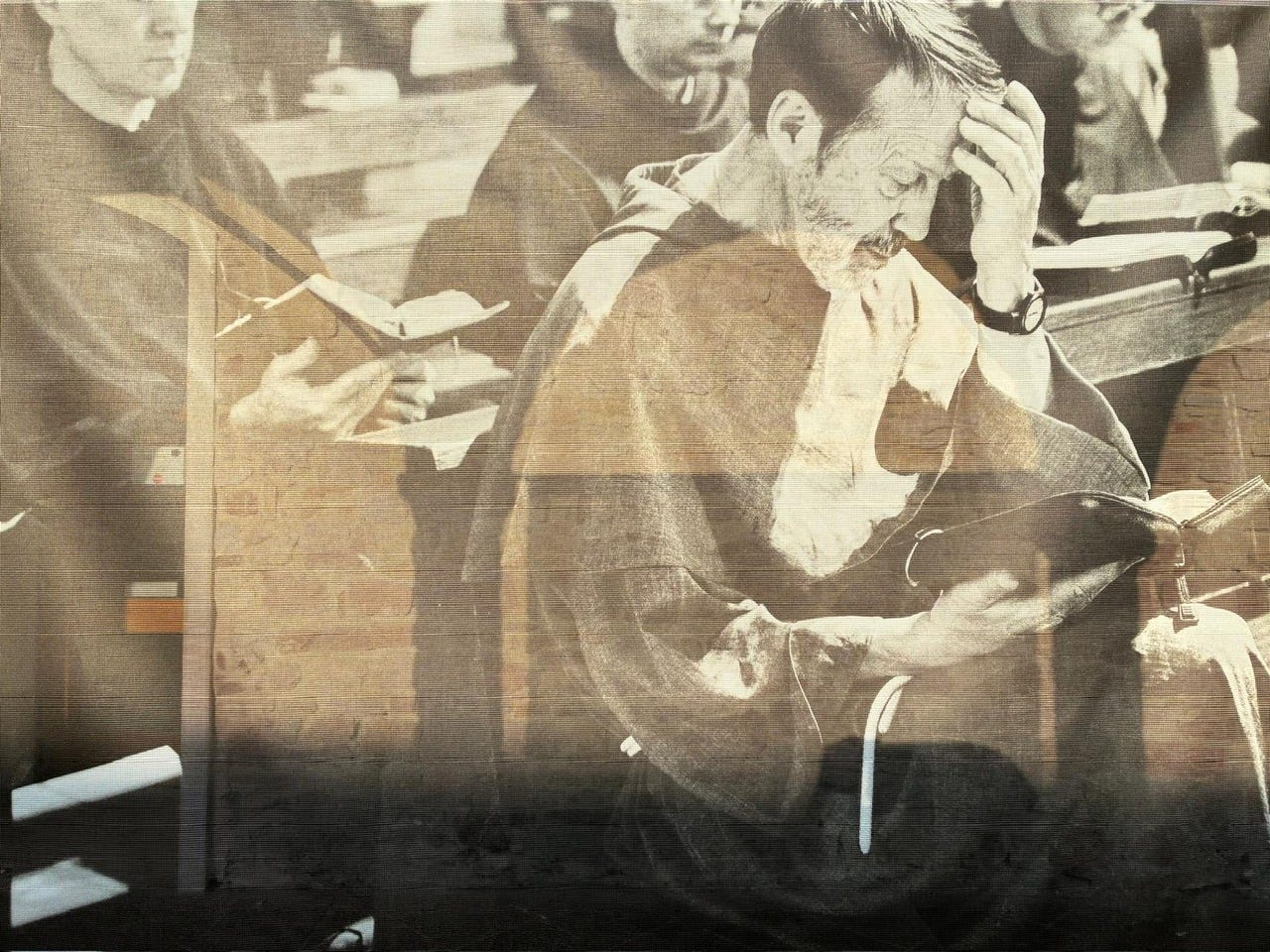
Was this what had brought C and I and 15,000 others—on the same weekend that the war began in Iran—to linger in the grey, stone streets of Assisi, to honor a man disowned by his family, who owned nothing, who gave what little he had away?
Maybe we just wanted to remember what humility was, what it might mean to unload for a minute the burden of our own age’s relentless ambition and hollow materialism.
Maybe we just wanted to prove Shakespeare wrong, to show that good too can live on long after the man himself has passed into dust.
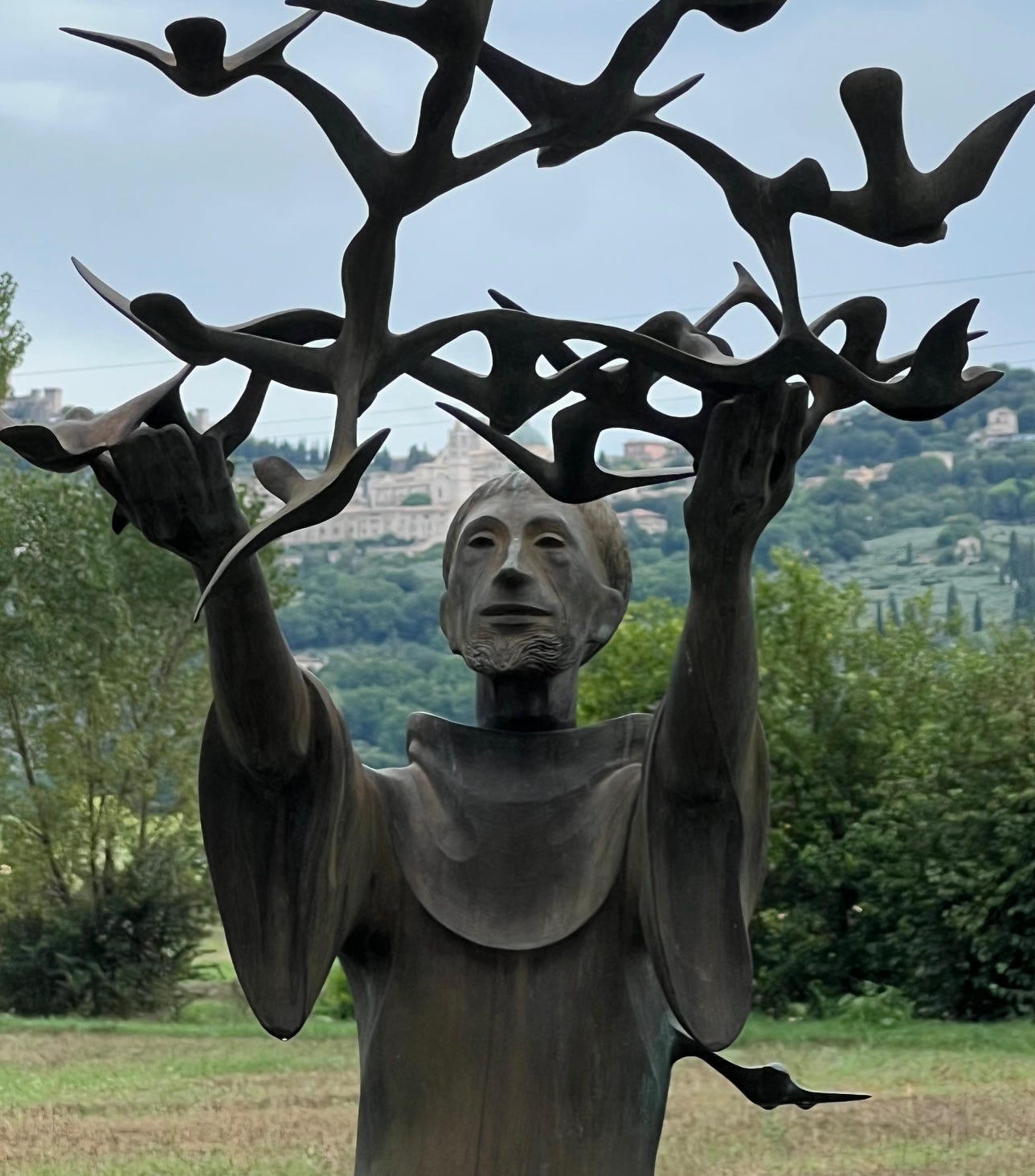
Taylor Zinser @ Trasimeno Archeology Field School. (2022)
I hesitate to say this, but ten minutes or so away by train is the little hilltop town of Spello, where my wife and I have an apartment. It's worth a few hours, for sure. And does attract some crowds on weekends--mostly Italian tourists--but nothing like Assisi.
I had this bookmarked and have just gotten around to reading it while on a break from finishing up my next post -- which is also about bones (!), but in a different context.
I need to make it back to Assisi. I've been five or six times over the years, but have not been in at last a decade. I remember a feeling of calm while there ... I'm guessing if I want that again I should go during the off-season.
It was a nice read. Thank you.